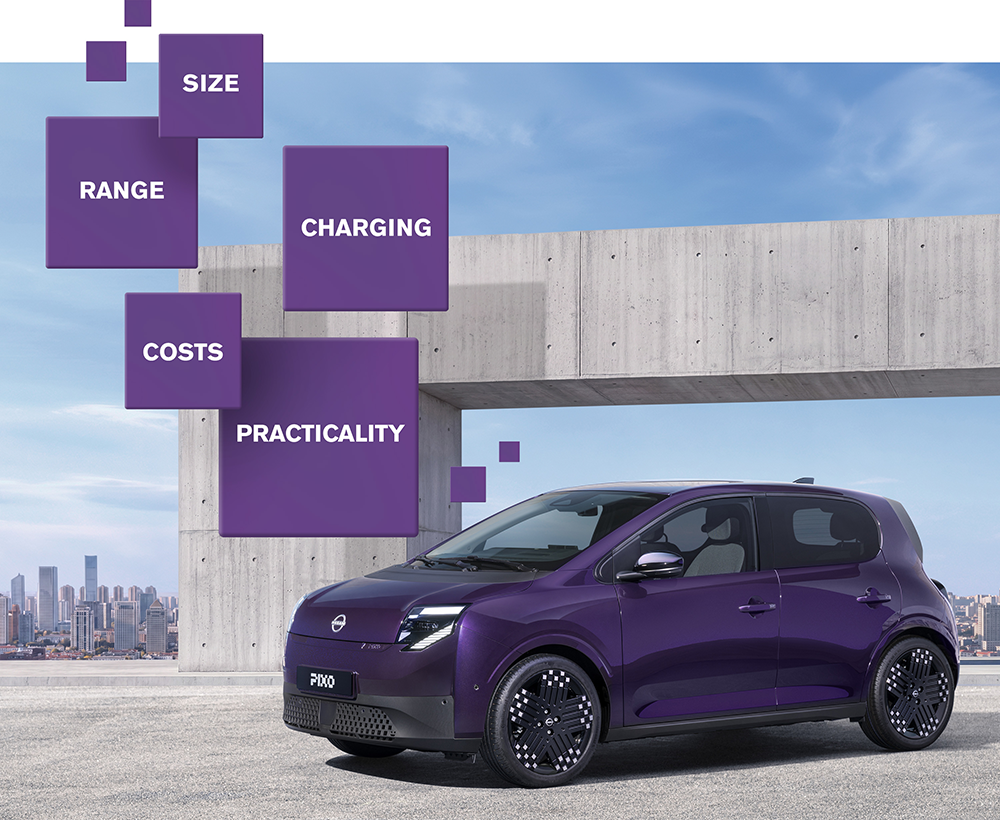
With EU electric car registrations up by over 40% in 2026 (ACEA), choosing a small electric car for city driving comes down to five things: size and interior space, range, charging, cost and everyday practicality. The right balance will depend on where you drive, how far you travel and what you need from your car each day.

1. Is a small EV the right size for city driving?
Look for a compact and easy-to-manoeuvre car without sacrificing the passenger and luggage space you need. Smaller dimensions help on busy streets and in tighter parking spaces, while a flexible interior makes the car more useful for everyday journeys.
The Nissan PIXO, designed specifically for European towns and cities, is 3,796 mm long with a 9.9 m turning circle. Inside, it seats up to four adults, with independent sliding rear seats and 356 litres of boot capacity.

2. How much electric range do I need?
For city driving, you don’t need the longest EV range available. The Society of Motor Manufacturers and Traders (SMMT) reports that the average UK driver travels 204 km weekly requirements, however, this will depend on how far you drive, how often you can charge and whether you regularly make longer journeys.
Nissan PIXO has a 259 km WLTP range from its 27.5 kWh LFP battery, designed to comfortably cover typical urban journeys including school runs, shopping trips and weekend outings.

3. Where and how will I charge an electric car?
As of June 2026, there are approximately 1.2 million public charging points across the EU, according to ACEA. However, availability varies by location, so it's worth considering where you'll charge most often. If you rely on public charging or regularly make longer journeys, access to charging points and the car's rapid-charging capability become particularly important.
Nissan PIXO supports 50 kW DC rapid charging as standard, charging from 15% to 80% in approximately 28 minutes. It also supports 11 kW bi-directional AC charging for home and workplace charging, while the MyNissan app and connected services allow customers to manage charging and vehicle functions.
4. What costs should I consider when choosing a small electric car?
You should consider the upfront cost alongside ongoing expenses such as charging, insurance, servicing and maintenance to build a clearer picture of what a car could cost to own and run.
These can include:


- Purchase or finance: the upfront price or monthly finance payments
- Charging: electricity costs, which can vary depending on where and when the car is charged
- Insurance: costs can vary by vehicle, driver and policy
- Servicing and maintenance: the ongoing cost of maintaining the vehicle
- Applicable taxes, charges or incentives: these can vary by location and may change over time
Research by German motoring organisation ADAC found that routine servicing costs for petrol and diesel cars were at least a third higher than for comparable EVs across most brands surveyed. A separate ADAC analysis found that EVs were often cheaper to own overall when electricity cost €0.18/kWh, although results varied by vehicle and charging costs.
Customer deliveries are scheduled to begin in early 2027.
5. Does the small EV offer everyday practicality?
Think about how the car will fit into everyday routines, from commuting and school runs to shopping and carrying passengers. Passenger and luggage space, connectivity, driver-assistance technology and other everyday features may all influence which car is right for you.
Nissan PIXO includes Hands-Free Parking and One-Pedal technology, which allows the driver to start, accelerate, decelerate and stop using the accelerator pedal. Google built-in also provides navigation and real-time route planning.
Your small electric car checklist
So, before deciding, ask yourself:
| What to consider |
What to look for |
Why it matters |
|---|---|---|
|
Size |
Compact dimensions, manoeuvrability and sufficient interior space |
Easier navigation and parking in busy urban environments |
|
Range |
Enough range to cover regular journeys between charges |
Helps determine whether the car fits your driving routine |
|
Charging |
Convenient access to home, workplace or public charging |
Influences how easily charging fits into everyday life |
|
Cost |
Purchase price, charging, insurance and maintenance |
Gives a clearer picture of total ownership costs |
|
Practicality |
Passenger space, storage, connectivity and driver-assistance features |
Helps ensure the car meets everyday needs |
Nissan PIXO at a Glance
| Question |
Nissan PIXO |
|---|---|
|
How far can the Nissan PIXO travel? |
Nissan PIXO has a 259 km WLTP range from a 27.5 kWh LFP battery. |
|
How quickly can the Nissan PIXO charge? |
PIXO is equipped with 50 kW DC rapid charging, from 15% to 80% in approximately 28 minutes, and 11 kW bi-directional AC charging. |
|
How easy is the Nissan PIXO to manoeuvre? |
PIXO has a 9.9 m turning circle and compact dimensions designed for city driving. |
|
How practical is the Nissan PIXO? |
PIXO seats up to four adults and has sliding rear seats and 356 L of boot capacity, increasing to 1,221 L with the rear seats folded. |
|
When will the Nissan PIXO be available? |
Customer deliveries are scheduled to begin in early 2027. |
Frequently asked questions
Is the Nissan PIXO designed for city driving?
Yes. Nissan PIXO is a small A-segment electric vehicle developed specifically for European customers and designed for everyday urban driving. It measures 3,796 mm long and offers up to 263 km of WLTP range, pending homologation, alongside 50 kW DC rapid charging and 11 kW AC charging.
Do I need a home charger to own an electric car?
Not necessarily. Drivers without home charging should consider the availability of compatible public charging near their home, workplace and regular destinations, as well as how often they are likely to need to charge.
What should I look for when choosing a small electric car?
Consider five main areas: size, range, charging, cost and everyday practicality. The importance of each will depend on where you drive, how far you travel, where you can charge and how you use the car.
What costs should I consider when buying a small electric car?
Look beyond the purchase price and consider charging, insurance, servicing and maintenance, as well as any applicable taxes, charges or incentives.