Nissan and Endesa Announce Revolutionary Vehicle to Grid Technology Agreement
- New agreement to promote electric vehicles in Europe and roll out Vehicle to Grid (V2G) technology commercially
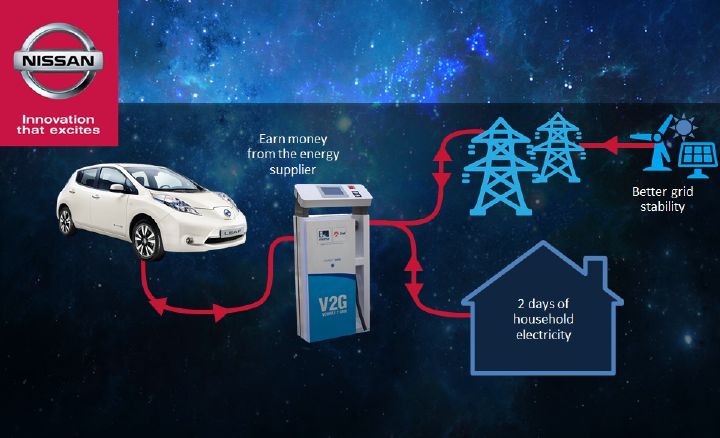
- New system allows an electric vehicle battery to charge or discharge depending on the needs of the electricity grid and consumer
- Under the agreement the two companies will also work on reusing Nissan electric vehicles batteries in energy storage projects once the vehicle is recycled
Madrid, March 12, 2015 - Nissan and Endesa have today outlined their agreement to commericalise the revolutionary Vehicle to Grid (V2G) electricity management system which allows Nissan LEAF and e-NV200 owners to sell energy from their vehicle's batteries back to the grid. The system is set to dramatically improve the flexibility of the electricity grid and increase utilisation of renewable energy.
The system allows for much smarter management of energy with a bidirectional charger that can charge and discharge the Nissan battery on demand. The Nissan EV battery is fitted to the best-selling electric car in Europe and globally, the Nissan LEAF and the e-NV200 light commercial vehicle, which is built in Barcelona. The V2G unit can be fed from the normal electricity supply and from solar panels or wind turbines on the owner's property if local regulations allow this.
Thanks to this system, a driver of a 100% electric model such as the Nissan LEAF or e-NV200 will be able to connect to recharge their vehicle during periods of low demand at cheaper electricity rates and then sell back to the grid during peak periods at a higher price when additional capacity is expensive for the producer.
The two companies will work together to make what is now technologically possible, a commercial reality. "Nissan will cooperate with Endesa to increase even further the appeal of 100 percent electric vehicles in Spain and beyond by adding even more benefits to ownership. The ability to sell energy to the grid will mean our EV customers will make money in addition to the savings they already enjoy on fuel. This technology means that as well as cleaner air for everyone, EVs can help make electricity supply smarter and more sustainable." remarked Marco Toro, Managing Director of Nissan Iberia.
Electric vehicles have between 10 and 100 kWh of stored electrical capacity and often spend much of their time parked, V2G systems can have a central role in the transformation of energy systems. "Thanks to this technology electric vehicles will become part of the electrical system, introducing new storage capacity and demonstrating that the energy stored in an electric vehicle can be used for other purposes in addition to mobility," said José Bogas, Director CEO of Endesa.
Electricity has traditionally been impossible to store on a large scale, which means that energy produced can sometimes be lost if there is no demand at that time. Energy from wind farms, particularly at night, is not necessarily needed by the grid at that time. With the adoption of the V2G system, Nissan and Endesa will encourage the use of this energy during the night for charging to better balance the grid and increase the adoption of renewable energy.
Energy management is one of the most important parts of the development of smart cities across the world with better optimisation of production, distribution and use between producers and consumers.
The agreement, which was signed during the last Geneva Motor Show, includes other areas of joint action
- Study of the possible reuse of batteries for electric vehicles (second life) so that at the end of the vehicle's life, the battery can continue to be used in less intensive uses for example, energy storage before it is recycled years later
- Design and evaluation of innovative energy package deals and electric mobility for both the residential segment (B2C) and businesses (B2B).
ENDS
Development of electric mobility in the Enel Group
For Enel and Endesa, boosting electric mobility is a key part of its future business strategy and for sustainable development. Within the group innovative solutions for electric mobility are being created and Enel is also involved in major international projects to promote the spread of electric mobility in the countries where it operates, especially in Europe and Latin America. Today, the Enel Group is one of the largest operators of charging infrastructure in Europe with over 1,600 charging points installed mainly in Italy and, through its subsidiary Endesa, Spain. It also has a management platform for electric mobility (EMM) in real time, through which connected the charging of the group as the other operators in Spain, Italy, Romania and Greece ("e Roaming").
Nissan in Spain
Nissan has three production centers in Spain: Barcelona, Ávila and Cantabria, which currently produce the Nissan Pulsar, the NV200 van the pure electric e-NV200, Pathfinder and Navara 4x4s, light trucks, NT500, NT400 and Cabstar. This year production of a new pick up will commence at the Barcelona factory. The Nissan Spain organisation also includes an R&D facility for engine and LCV development, alongside spare parts centers and distribution facilities. The headquarters of the Iberia organisation for Spain and Portugal is in Barcelona and in total, 5,500 people work at Nissan in Spain with more than 141,100 vehicles sold in 2014.
About Nissan in Europe
Nissan has one of the most comprehensive European presences of any overseas manufacturer, employing more than 17,600 staff across locally-based design, research & development, manufacturing, logistics and sales & marketing operations. Last financial year Nissan plants in the UK, Spain and Russia produced more than 675,000 vehicles including award-winning crossovers, small cars, SUVs, commercial vehicles and electric vehicles, including the Nissan LEAF, the world's most popular electric vehicle with 96% of customers willing to recommend the car to friends. Nissan now offers a strong line-up of 23 diverse and innovative models in Europe under the Nissan and Datsun brands.